Built to Specification, Solved the Wrong Problem: When Custom Software Delivers Exactly What Nobody Needed
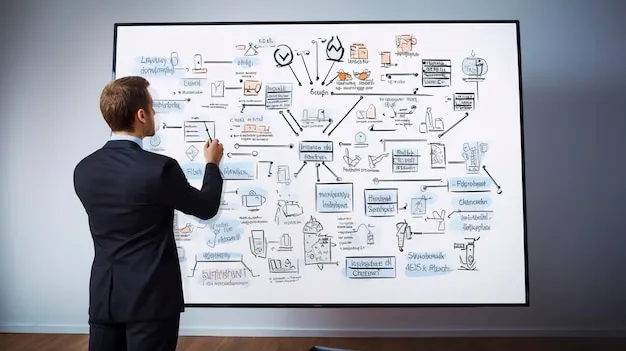
Photo: business meeting software requirements whiteboard strategy planning, via img.freepik.com
There is a particular category of custom software failure that is especially difficult to diagnose because it does not look like failure at first. The vendor delivered on time. The code passes its acceptance tests. The features match the requirements document point by point. And yet, within months of launch, it becomes clear that the software does not solve the problem the organization actually had.
This is not a story about vendor incompetence or client negligence. It is a story about the structural limitations of specifications as a mechanism for communicating complex business problems—and about what happens when neither party has built the relationship or the contractual flexibility to recognize and respond to that limitation.
How a Correct Specification Can Describe the Wrong Problem
Requirements documents are necessarily written in advance of full understanding. The act of commissioning custom software is, in part, an act of translating a business problem into technical language—a translation that happens before the translator has complete information about either the source or the destination.
Organizations often begin this process with a strong understanding of the symptoms they are experiencing: slow processes, manual workarounds, data inconsistencies, reporting gaps. What they frequently lack is a rigorous analysis of the underlying causes. The requirements document, as a result, describes solutions to the symptoms rather than the structural conditions that produced them.
A vendor executing against that document will build exactly what was asked for. The software may perform flawlessly according to its specification and still fail to address the root problem—because the root problem was never accurately diagnosed.
The Signals That Appear During Development
Misalignment between specification and actual need rarely stays invisible throughout the development process. It tends to surface in specific, recognizable forms that go unaddressed because neither party has established a mechanism for responding to them.
One common signal is the "that's not how it actually works" moment—a point during user story review or prototype demonstration when a business stakeholder realizes that the workflow being built reflects an idealized or outdated version of the process rather than the one that actually operates in the organization. These moments are frequently logged as scope clarifications and resolved through minor adjustments, when they should trigger a broader reassessment of the requirements foundation.
Another signal is the emergence of workaround requests during development. When stakeholders begin asking for features that exist primarily to accommodate exceptions to the system's core logic, it often indicates that the core logic was modeled on assumptions that do not hold in practice. The workarounds are symptoms of a specification that was built on an incomplete understanding of the business environment.
A third signal is stakeholder disengagement from the review process. When the people who will actually use the software stop showing up to demonstrations or begin delegating their feedback to proxies, it sometimes reflects a growing sense that the project is not building toward something that will genuinely serve their needs. That disengagement is rarely articulated directly—it manifests as scheduling conflicts and delegated approvals—but it carries important diagnostic information.
Why Vendors Rarely Raise the Flag
A vendor who identifies a potential misalignment between the specification and the client's actual need faces a genuinely difficult choice. Raising the concern risks disrupting a project that is progressing smoothly, introducing scope uncertainty that neither party wants, and potentially surfacing a conflict about who bears responsibility for a requirements failure.
The path of least resistance is to continue executing against the specification. The vendor is, after all, doing exactly what was contracted. The client approved the requirements. The acceptance criteria are clear. From a contractual standpoint, the vendor's position is defensible.
This dynamic is not unique to any particular vendor type or engagement model. It is a structural feature of fixed-scope, specification-driven contracts that creates incentives for continued execution even when execution is producing the wrong outcome.
Designing Contracts That Allow for Course Correction
The most effective protection against specification failure is a contract structure that anticipates it. This does not mean abandoning scope definition—it means building in mechanisms for structured reassessment at defined intervals throughout the project.
Milestone-based reviews that explicitly include a requirements validation component—not just a progress review—create opportunities to surface misalignment before it becomes expensive. These reviews should include direct input from end users, not just project sponsors, and should be structured to ask whether the software being built will actually solve the problem that motivated the project, not merely whether it matches the specification.
Change management provisions matter equally. Contracts that treat any deviation from the original specification as a change order requiring additional budget create strong disincentives for raising legitimate concerns about direction. Contracts that include a defined allowance for requirement refinement—without triggering adversarial renegotiation—make it safer for both parties to acknowledge when the original direction needs adjustment.
The Relationship Structure That Makes Honesty Possible
Beyond contract mechanics, the client-vendor relationship itself determines whether misalignment can be surfaced and addressed. In relationships characterized by arm's-length formality and strict role separation, the friction required to raise a fundamental concern about project direction is often prohibitive. The concern gets filtered, softened, or deferred until it can no longer be ignored.
Relationships structured around genuine partnership—where the vendor is expected to bring strategic perspective, not just technical execution—create different conditions. The vendor's role includes the obligation to raise concerns about whether the work being done is serving the client's actual interests, even when those concerns are uncomfortable.
This kind of relationship requires deliberate cultivation. It begins in the sales and scoping process, where the vendor's approach to requirements discovery signals whether they are capable of genuine engagement with the business problem or primarily skilled at translating a brief into a deliverable.
When the Discovery Happens After Delivery
In cases where misalignment is not identified until after the software has been delivered and deployed, the options narrow considerably—but they do not disappear.
The first step is an honest assessment of what the software actually does well. Even a system that fails to solve the primary problem it was designed for often contains components, integrations, or data structures that have genuine value. Understanding what can be salvaged informs the cost of remediation.
The second step is a structured retrospective on the requirements process—not to assign blame, but to understand specifically where the translation from business problem to technical specification broke down. That understanding is essential both for designing the remediation approach and for preventing the same failure in subsequent development phases.
The third step is a realistic conversation between client and vendor about shared responsibility. In most cases of specification failure, both parties contributed to the conditions that produced it. Contracts that make this conversation impossible—that force it into a binary of vendor liability versus client acceptance—tend to produce outcomes that are worse for both parties than a collaborative remediation agreement.
The goal, ultimately, is software that solves the actual problem. Getting there sometimes requires the willingness to acknowledge, clearly and without defensiveness, that the path taken so far has not led to that destination—and to redesign the route accordingly.