Governance Gaps in Plain Sight: What Your Code Review Process Is Failing to Protect

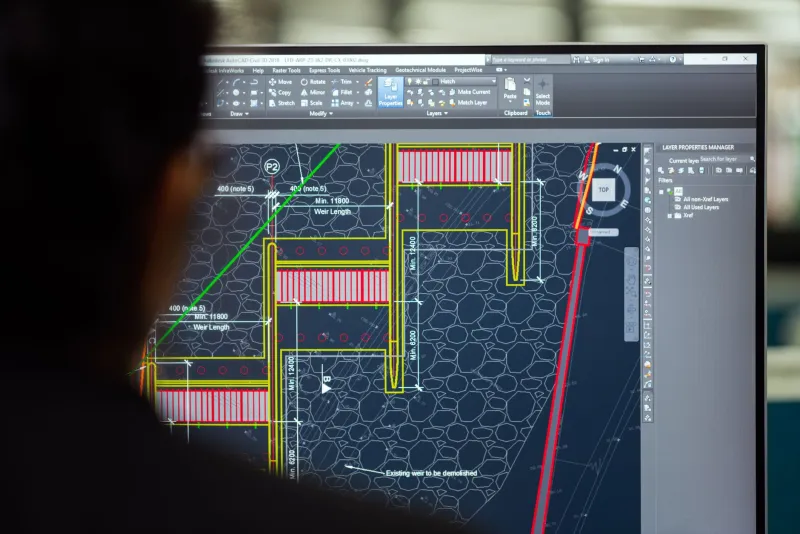
Photo: executive reviewing code audit documentation on computer screen in office, via i.pinimg.com
The Assumption That Creates the Exposure
When a business commissions a custom software project, the conversation at the executive level tends to focus on deliverables: features, timelines, integration requirements, and launch milestones. Code governance — the internal discipline that governs how code is reviewed, approved, documented, and audited — rarely enters those discussions. It is presumed to exist, operating quietly in the background as a matter of professional competence.
That presumption is one of the more costly mistakes an organization can make.
Code review processes and audit trails are not incidental housekeeping tasks. They are the structural record of how decisions were made inside a software system — who approved a change, when it was introduced, what it replaced, and whether it met the organization's stated security, compliance, or quality standards. When those records are absent or superficial, the organization does not simply have a technical gap. It has a governance gap, and governance gaps carry consequences that extend well beyond the engineering team.
What a Functional Code Governance Framework Actually Requires
The term "code review" is used loosely across the industry, and that imprecision contributes to the problem. In some development environments, code review means a senior developer briefly scans a pull request before approving it. In others, it means a structured process involving automated static analysis, peer review against defined standards, security scanning, and documented sign-off before any change reaches production.
The difference between these two interpretations is not stylistic. It is material to how an organization will fare when scrutinized.
A functional code governance framework encompasses several interdependent elements. First, every code change should be traceable to a specific requirement, ticket, or business decision — establishing a clear chain of intent. Second, reviews should be conducted by qualified individuals who are neither the original author nor under undue pressure to approve changes quickly. Third, automated tooling should scan for known vulnerability patterns, dependency risks, and compliance-relevant code constructs before human review even begins. Fourth, all approvals, rejections, and revision cycles should be logged in a durable, tamper-resistant system that can be produced on demand.
Organizations that operate without these elements do not simply have a weaker development process. They have created a set of conditions in which critical business risk can accumulate invisibly, and in which that risk will surface at the worst possible moment.
Why Development Teams Abandon These Practices Under Pressure
Understanding how governance gaps form requires acknowledging a structural tension that exists in almost every custom software engagement. Deadlines and budget constraints create real pressure on development teams, and code review processes are among the first disciplines to compress when that pressure intensifies.
The logic is understandable, if short-sighted. A review cycle that normally takes two days gets reduced to two hours. Automated scanning tools get bypassed because they are flagging issues the team has decided to address in a future sprint. Documentation of review decisions gets deferred indefinitely. Senior reviewers, stretched across multiple workstreams, begin approving changes with less scrutiny than the process formally requires.
None of this is typically malicious. It reflects the ordinary behavior of skilled professionals managing competing demands. But the cumulative effect is a codebase whose governance record is unreliable — one that cannot be accurately audited, one whose security posture cannot be confidently attested to, and one that may contain decisions that were never formally reviewed at all.
For the business commissioning the work, this creates a liability that is difficult to detect from the outside. The software functions. The project delivers. The internal development metrics may look entirely acceptable. The governance failures are embedded in the process, not the output, and they remain invisible until something forces them into view.
The Moments When Invisible Risk Becomes Visible Consequence
Three scenarios consistently expose inadequate code governance at the worst possible time for the organizations involved.
The first is a regulatory compliance audit. In industries subject to HIPAA, SOC 2, PCI DSS, or state-level data privacy regulations, auditors frequently request evidence of change control processes, access management records, and security review documentation. When an organization cannot produce a coherent audit trail — because the development process never generated one — it faces findings that can range from costly remediation requirements to regulatory penalties. The software itself may be entirely functional; the documentation of how it was built and governed is what fails the audit.
The second is a security incident. When a breach or unauthorized access event occurs, the forensic investigation that follows depends heavily on the quality of the organization's code governance records. Organizations with robust audit trails can often identify the specific change that introduced a vulnerability, the date it was deployed, and who approved it. Organizations without those records face far longer investigation timelines, broader uncertainty about the scope of exposure, and a materially weakened position with insurers, regulators, and affected parties.
The third is a due diligence process during a merger, acquisition, or significant financing event. Technical due diligence has become a standard component of M&A transactions involving companies with proprietary software assets. Acquirers and their advisors increasingly evaluate code governance as a proxy for overall organizational maturity. A codebase that lacks a coherent review history, carries undocumented dependencies, or shows evidence of bypassed security controls will raise questions that affect valuation — or, in some cases, derail the transaction entirely.
What Executives Should Be Asking Their Development Partners
The appropriate response to this risk is not to second-guess every technical decision made by a development team. It is to establish, at the outset of any custom software engagement, that code governance is a contractual and operational expectation — not an assumed courtesy.
Executives and technology leaders should be asking their development partners direct questions about how code reviews are structured and enforced. They should request documentation of the tooling used for automated scanning and the thresholds that determine whether a change can proceed. They should understand who has authority to approve exceptions to the review process, and how those exceptions are recorded. They should confirm that audit trail data is stored in a format and location that remains accessible to the organization — not exclusively within the vendor's internal systems.
They should also establish periodic governance reviews throughout the project lifecycle, not only at delivery. A codebase that enters a six-month development cycle with strong governance practices can exit that cycle with significant gaps if nobody is monitoring process adherence along the way.
The Cost of Discovering This Later
Code governance is not an abstract engineering concern. It is a business continuity issue with direct financial and legal dimensions. The cost of establishing rigorous review practices from the beginning of a project is modest relative to the cost of reconstructing governance records after a compliance finding, rebuilding trust with an acquirer after due diligence uncovers process failures, or managing the fallout from a security incident whose origin cannot be clearly traced.
Organizations that commission custom software are making significant investments in proprietary capability. Protecting that investment requires more than ensuring the software works as specified. It requires ensuring that the process by which it was built can withstand scrutiny — because eventually, in one form or another, it will face exactly that.